Xventure Singapore Tickets: $33 for 2 Hours, $9 for a Third
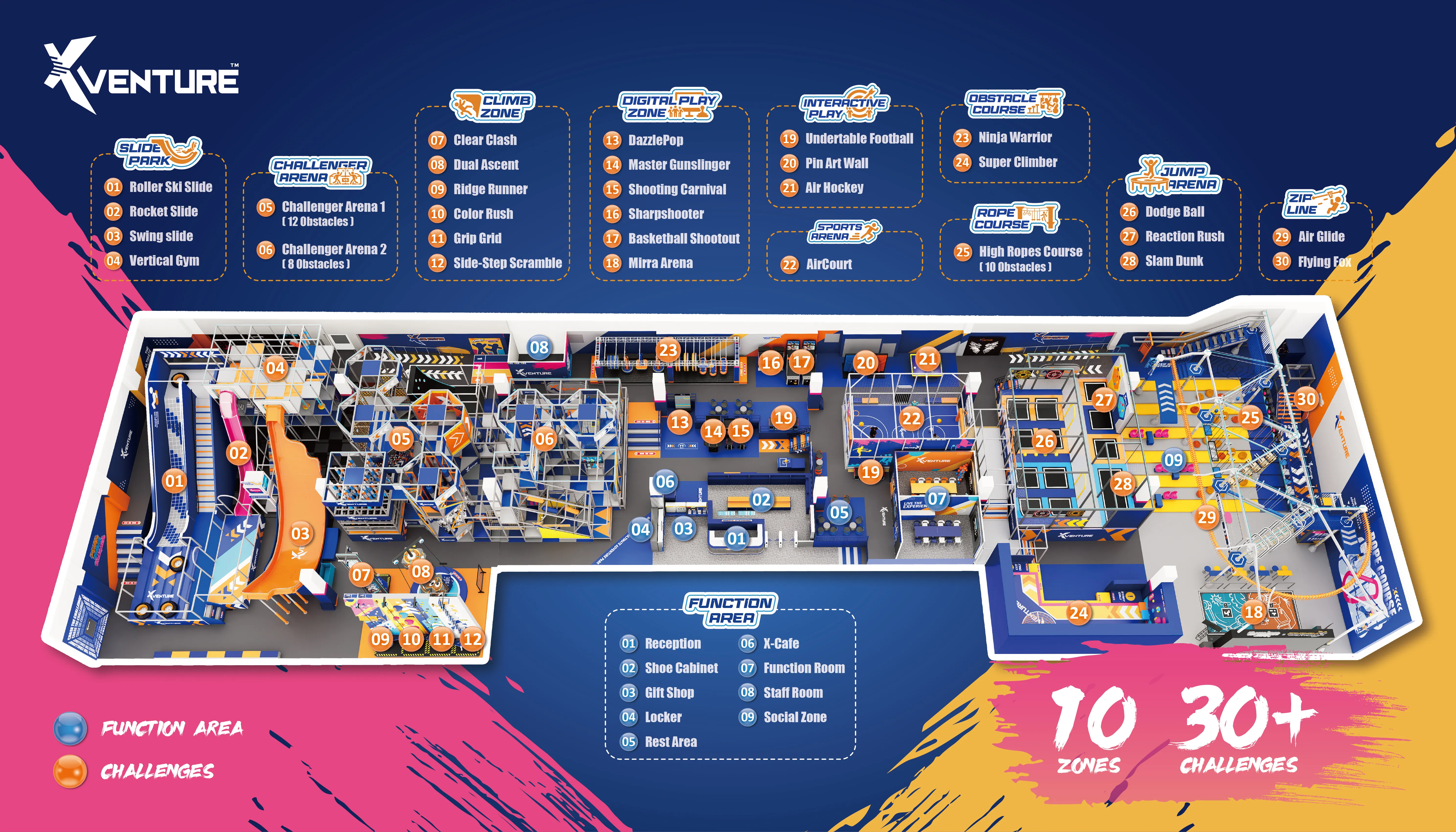
On 20 November 2026 the company behind Kiztopia opens Xventure at Tiong Bahru Plaza, on level 4 in units #04-104/105, in the mall’s former cinema. The park is 1,900 m² (20,451 sq ft) across ten zones, with more than thirty numbered challenges and nine function areas behind the play floor.
The published price list carries six numbers: $33, $42, $18, $48, $118 and $268. All six are in Singapore dollars, and all six are about time rather than about equipment. That is the interesting part, and it is the part a buyer can actually use.
A price ladder is not marketing. It states who the operator expects to walk through the door, how long that person will stay, and therefore how much building the operator has to rent. Read it that way and the six numbers stop being retail trivia and start being a capacity specification.
This article reads the ladder, runs the arithmetic a buyer would run before signing a lease, and compares it with the same brand’s Malaysian outlet, which opens twenty-four days ahead of it. It does not assess the park’s safety and it does not review the experience. Xventure has not published its zone areas, its capacity limit or its build cost, and we are not going to invent them.
One dating note, because it matters for anything you read elsewhere: the outlet was announced in October 2026 and opens on 20 November 2026. Prices below come from the operator’s own flyer and outlet page, both read on 28 October 2026.
1. The Park, in the Numbers Xventure Has Published
The first thing to establish is how little is on the record, because a buyer’s checklist should start with what is missing rather than with what is glossy.
| Item | Published value | Where it comes from |
|---|---|---|
| Location | Level 4, #04-104/105, Tiong Bahru Plaza, 302 Tiong Bahru Road | Operator outlet page |
| Previous use of the space | Mall cinema | Opening announcement |
| Floor area | 1,900 m² (20,451 sq ft); the announcement says 20,000 sq ft | Outlet page and announcement, October 2026 |
| Play zones | 10 | Outlet page and park map |
| Challenges | More than 30, individually numbered on the map | Park map, revised 13 October 2026 |
| Function areas | 9, including X-Cafe, function room and social zone | Park map |
| Opening hours | Monday to Thursday 10.30am to 8.30pm; Friday to Sunday and public holidays 10am to 9pm | Outlet page |
| Visitor claim | 500 or more daily visitors | Outlet page |
| Build cost | Not published | Absent from all three sources |
The two area figures differ by 451 sq ft, about 2.3%. It is a rounding habit rather than a discrepancy worth arguing about, but it decides which number you use for arithmetic. Take the metric figure, because it is the operator’s own, and convert at 10.7639 sq ft to the square meter.
Opening hours matter before anything else, because every capacity calculation in this article depends on them. Ten hours on four weekdays plus eleven hours on three weekend days gives 73 open hours a week. Across 52 weeks that is 3,796 open hours a year, or 10.4 open hours on an average day.
Ten zones is a shorthand that hides a real split. The park map lists a Slide Park with four units, two Challenger Arenas labeled with 12 and 8 obstacles, a Climb Zone with six, a Digital Play Zone with six, an Interactive Play area with three, an Obstacle Course with two, a Jump Arena, a Rope Course, a Sports Arena built around an AirCourt, and a Zip Line. Twenty of the thirty-plus challenges sit inside the two Challenger Arenas, which is why those are the only zones whose obstacle counts the operator prints in the label.
The headline attraction in the announcement is a MIRRA arena, described as the first in Singapore, where players move through a shared virtual world while spectators watch on a large screen. The physical centerpiece is a 30 m (98 ft) glide at the end of an eleven-element elevated route. Neither of those is a trampoline, and that fact drives the compliance discussion in section 6.
| Zone | Units listed on the map | What it demands of the building |
|---|---|---|
| Challenger Arena | Two arenas, 12 and 8 obstacles | Clear span and a padded perimeter |
| Climb Zone | Six | Wall height plus fall arrest or matting depth |
| Digital Play Zone | Six | Power, network and screen sightlines |
| Slide Park | Four | Vertical drop and run-out at the bottom |
| Interactive Play | Three | Floor loading and wall fixing |
| Zip Line | One glide, 30 m | Uninterrupted length plus a landing run-out |
| Jump Arena, Rope Course, Sports Arena, Obstacle Course | Eight between them | Varies by element |
Treat that table as a shopping list of constraints rather than a description of a design. The map is a marketing drawing with numbered bubbles. It carries no dimensions, zone areas or circulation widths. It is enough to tell you what to ask for, and nowhere near enough to design from.
2. Six Prices on One Axis
Here is the whole ladder, transcribed from the operator’s flyer, with the per-hour and share-of-base figures calculated from it rather than published.
| Product | Session | Price | Per hour | Per entry versus $33 |
|---|---|---|---|---|
| Standard, 120 cm and above | 2 hours | $33 | $16.50 | 100.0% |
| Standard, 120 cm and above | 3 hours | $42 | $14.00 | 127.3% for 150% of the time |
| Junior, below 120 cm | 2 hours | $18 | $9.00 | 54.5% |
| Family Pair, one adult plus one child below 120 cm | 2 hours | $48 | $24.00 per head | 94.1% of the $25.50 un-bundled average |
| X4 shareable pass, four entries | 4 x 2 hours | $118 | $14.75 | 89.4%, or $29.50 |
| X10 shareable pass, ten entries | 10 x 2 hours | $268 | $13.40 | 81.2%, or $26.80 |
Read the session column as the only genuinely free variable in the list. Two hours is the floor of the ladder and there is no one-hour ticket at any price. The flyer’s own line for the upgrade is “50% more playtime for only $9 more”, which is accurate and, at the same time, the most important sentence on the page.
Height appears exactly once, as a single junior tier at $18 that has no three-hour option at all. Compare that with what the same brand does in Malaysia (section 7) and the choice becomes conspicuous: in Singapore, height is a discount for small children, not a way of organizing the whole price list.
The saving claims on the flyer check out. Four standard two-hour tickets would cost $132 and the X4 pass costs $118, a saving of $14. Ten would cost $330 against $268, a saving of $62. Both figures are true, and both are small: 10.6% and 18.8%.
What the ladder does not contain is as informative as what it does. There is no all-day ticket, no monthly product and no annual pass, either on the flyer or on the reseller listing. A park that expects its guest to come back every week normally sells one. This one sells sessions and packs instead, and its sister outlet, three weeks older, sells the annual pass too.
3. The Third Hour Sells at 55% of the First
Take the two standard prices apart. The average rate at two hours is $16.50 an hour. The third hour adds $9.00, which is 54.5% of that average, for 50% more time. The guest pays 27.3% more money and gets half again as long inside.
That is not a mistake and it is not generosity. It is what an operator charges when the marginal cost of the extra hour is close to nothing. The guest is already through the till, already wearing the required socks, already inside the tenancy. The incremental cost of the third hour is wear on the beds and padding, a little more cleaning, and one thing that does cost real money: the space that guest occupies while somebody else waits outside.
The rule this price encodes: sell time cheaply until the room is full, then stop selling time. The $9 third hour is a capacity instrument wearing a discount’s clothes.
Whether it works depends entirely on a number the operator has not published, which is the concurrency ceiling. Section 4 puts a range around it using the only public figure available, the visitor claim on the outlet page.
A second-order effect matters if you copy this structure. A cheaper third hour raises average dwell time, and dwell time is what a cafe and a gift shop earn against. X-Cafe sits in the function area list for a reason. Every extra half hour a guest spends inside is a chance to sell a drink, and the margin on a drink is better than the margin on a jump session. The third-hour discount is partly paid for by the second purchase it makes possible. That argument only holds if the cafe sits inside the tenancy and near the exit route, which the map suggests but does not prove.
4. What a Two-Hour Minimum Does to Occupancy
Little’s law is the whole of this section. The average number of people inside equals the arrival rate multiplied by the average time each one stays. Daily visitor counts do not size a building. Concurrent bodies do.
Concurrent guests = arrivals per open hour x length of stay in hours
Arrivals per open hour = daily visitors / 10.4 open hours

At 500 daily visitors: 48.1 arrivals per open hour
1-hour ticket  =  48.1 concurrent
2-hour ticket  =  96.2 concurrent
3-hour ticket  = 144.3 concurrent
Divide the floor area by those figures and the same 20,451 sq ft yields very different amounts of room per person.
| Average stay | Concurrent guests at 500 a day | Floor area per guest | Guests per zone across ten |
|---|---|---|---|
| 1 hour | 48 | 425 sq ft (39.5 m²) | 4.8 |
| 2 hours | 96 | 213 sq ft (19.8 m²) | 9.6 |
| 3 hours | 144 | 142 sq ft (13.2 m²) | 14.4 |
The 500 figure is a claim on the operator’s outlet page, not an audited attendance count, and it may describe capacity rather than typical trade. Use it as an upper bound. The ratios hold at any volume: if the real number is 300 a day, every concurrency figure falls by 40% and the area per guest rises by two thirds.
Now put the two decisions together. The upgrade from two hours to three raises ticket revenue per guest by 27.3% and raises the number of bodies the building must hold by 50%. If a meaningful share of guests take the upgrade, the park’s peak occupancy is set by the three-hour case, and the design has to answer for 144 people rather than 96. That is what the $9 buys, and it is why the concurrency ceiling matters more than the ticket price.
Ten zones with 144 people inside works out at 14 per zone at peak, which is roughly where a queue forms at anything with a single entry point. The MIRRA arena is the obvious candidate. A shared virtual world runs a fixed number of players per round, and the reseller’s terms say queue time for the virtual reality experience counts inside the purchased session. A guest who spends twenty of their hundred and twenty minutes in a queue has bought a hundred minutes. The operator has not published the station count or the round length, so throughput of that single attraction cannot be calculated from public information.
Supervision scales with zones, not with bodies. Roughly, the staffed posts you need are the number of zones divided by the number of zones one person can watch, and the annual cost is posts multiplied by open hours. At five posts and 3,796 open hours that is 18,980 staffed hours a year before any allowance for holiday cover. Which zones can share a post is a sightline question, and it is the one design decision that quietly sets the labor budget.
For how much of a park’s supervision cost is geometry rather than staffing, see what supervision cannot fix.
5. The Chaperone Is a Paid Seat
The reseller listing states the rule plainly: visitors aged 12 and under must be accompanied and supervised by an adult aged 18 or over who holds a separate valid ticket. Not a wristband, not a free pass. A ticket.
That turns supervision into a product line, and the family bundle prices it almost at full freight. One adult at $33 plus one junior at $18 comes to $51; the Family Pair sells the same two hours for $48. The discount is $3, or 5.9%.
Compare the equivalent bundle at the Malaysian outlet, where one junior plus one explorer for two hours costs RM90 against RM100 bought separately. That is 10% off. The same brand discounts the parent-and-child pair half as much in Singapore as it does in Penang.
Read with section 2, the pattern is consistent rather than accidental. Singapore’s deepest discount is on the ten-entry share pack, at 18.8%. Penang’s share pack is RM510 for ten explorer tickets, which is RM51 each against RM60, or 15% off. The two outlets have made opposite choices: Singapore discounts the repeat multi-visit product and protects the family bundle, while Penang discounts the family pair and protects the pack.
Those choices describe two different customers. Penang is selling a day out to a family that has driven to a new waterfront development; the unit of purchase is the household, and the household has a child in it. Singapore is selling two hours to someone who arrived by MRT, probably after school or after work, who will come back with the same three friends. The unit of purchase is the person, and the person is old enough to buy their own ticket.
The missing annual pass is the most interesting omission on the Singapore list. Memberships and passes are what convert a venue with a teenage catchment into recurring revenue, and the mechanics of that conversion are covered in how membership pricing changes cash flow. A ten-entry pack sold at 18.8% off is a substitute for a membership, not the same instrument: it prepays ten visits but commits the guest to nothing beyond them, and there is no renewal moment to sell against.
6. Ten Zones, More Than One Rulebook
The most useful thing about a multi-zone box is also the thing buyers underestimate: equipment standards do not cover the building, and most of these zones are not trampoline parks in the sense the standards define.
EN ISO 23659:2022, published in November 2022 and confirmed in 2024, sets safety requirements for the design, construction, inspection and maintenance of trampoline parks and their components. Its scope expressly includes trampoline park areas inside multi-activity parks, and it also covers airbag and foam-pit landing areas. It then lists what it does not cover: general building regulations, fire regulations, planning regulations, food and drink provision, and non-trampoline activities such as artificial climbing, parkour and obstacle courses.
Hold that list against the park map. The Climb Zone’s six units are climbing. The Obstacle Course is an obstacle course. The 30 m glide is an aerial element. The two Challenger Arenas are obstacle-based competition. On the standard’s own wording, several of the ten zones sit outside the document most people would assume governs the whole site.
What this means in practice: your compliance matrix has one row per zone, not one row per venue. The count of rows, not the price of the equipment, is what makes a ten-zone box expensive to certify and slow to open.
Nothing here says Xventure has done this badly. The operator has not published which standards it designs to, and inferring one from its other outlets would be guesswork. The point is procedural: when you buy equipment for a site like this, ask for the declaration of conformity per zone, not for the venue. A single certificate covering the whole park is a document that cannot exist.
For the trampoline element specifically, ASTM F2970 covers commercial trampoline courts in the United States and ASTM F1918 covers soft contained play. Those documents use different methods and different vocabularies, and translating a threshold from one into the other is how projects end up with a design that satisfies nobody’s inspector. Ask which document your market’s authority actually enforces, then read its scope. Our own summary of the certification landscape is at safety standards.
One physical detail is worth taking from the announcement. A 30 m glide inside a mall floor plate is not constrained by the launch platform; it is constrained by the landing. The line needs braking distance and a run-out that does not discharge into a circulation path, and the length of that run-out plus the brake set the minimum length of the zone. When a supplier shows you a render of a zip line, ask for the landing zone drawing. The render is a picture of the easy end.
Zone counting also matters commercially, and not in the direction most buyers expect: more named attractions per square foot does not automatically mean more revenue per square foot, because each zone carries a fixed supervision and maintenance cost that does not shrink with its area. We counted five 2026 openings on that basis in what attraction density actually looks like.
7. Penang, Twenty-Four Days Earlier: The Other Ladder
Xventure opens its first Malaysian outlet at The Waterfront Shoppes in Penang on 29 October 2026, twenty-four days before Singapore. It is 1,800 m² (19,375 sq ft) with eleven zones, and the company put a number on the build: RM8 million. That comparison makes the Singapore pricing legible, because almost everything else about the two projects is the same.
| Dimension | Penang, opening 29 October 2026 | Singapore, opening 20 November 2026 |
|---|---|---|
| Area | 1,800 m² | 1,900 m² |
| Zones | 11 | 10 |
| Build cost | RM8 million, disclosed | Not disclosed |
| Pricing axes | Height tier, session length and peak day | Session length plus one junior tier |
| Shortest session | 2 hours | 2 hours |
| Longest session | All day | 3 hours |
| Junior gate | 108 cm and shorter | Under 120 cm |
| Adult to junior ratio, 2 hours | 1.50 to 1 | 1.83 to 1 |
| Parent and child bundle | 10.0% below the sum of parts | 5.9% below the sum of parts |
| Multi-entry pack | 15.0% below the single price | 18.8% below the single price |
| Annual pass | RM900 for 12 months | None published |
Four differences carry all the meaning. Singapore deletes the all-day product, which removes the day-tripper. Singapore keeps a height gap but leaves it as a single tier, which tells you the adult is the volume guest. Singapore discounts the multi-entry pack deeper than Penang does and the family bundle less, which swaps the household for the friend group as the target purchase. And Singapore publishes no annual pass at all, so repeat revenue depends on selling packs again rather than on renewing a membership.
None of that is a criticism. A 1,900 m² box on level 4 of a suburban mall with an MRT station underneath is not the same asset as a 1,800 m² box on level 2 of a new waterfront development with a tourist catchment. The reason to put the two side by side is that the same operator, with the same zone kit and the same brand, priced them differently within four weeks. That is what a price ladder looks like when it is doing its job: a read on the local demand curve, not a template.
The Penang ladder, including its height-tiered ticketing and the reasoning behind it, was covered in the Penang opening. The Singapore version is a different instrument aimed at a different guest, which is exactly why it deserves a separate read rather than an update.
8. Decision Rules, and What Is Still Unknown
The ladder is a transferable set of conditions rather than a template. Here is when each structure earns its keep.
| If this describes your site | Then price it this way | Because |
|---|---|---|
| Catchment arrives by public transport for short blocks | Two-hour base with a cheap third hour | Dwell time is the only thing you can sell twice |
| Catchment drives 40 minutes or more | Keep an all-day product | A three-hour cap tells a day-tripper to go elsewhere |
| Birthdays exceed a quarter of revenue | Keep a 90-minute product | Cake and room turnaround turn a two-hour slot into three hours |
| Weekends are full and weekdays are empty | Sell a transferable multi-entry pack | It breaks a group decision into four solo decisions |
| Weekdays are already 60% full | Do not sell the pack | A discount with no demand shift is just a discount |
| You have not measured the concurrency ceiling | Do not discount the long session | You are selling capacity you cannot verify you have |
Two of those rules are worth stating as arithmetic rather than advice. A third-hour discount of the size Xventure uses raises revenue per guest by 27.3% and concurrency by 50%; if the room is already at its ceiling at two hours, the extra money is bought with queues. And every dollar taken off the average ticket has to come out of rent headroom, because rent is a fixed cost that does not care what you charged.
What remains unpublished is a short list, and each item is something to ask a supplier or an operator directly rather than to infer from a render.
- Zone areas and circulation widths. The park map is a marketing drawing with numbered bubbles and no dimensions.
- Maximum occupancy. No capacity limit appears in any of the published sources, so the concurrency figures in section 4 are arithmetic, not a specification.
- Throughput of the MIRRA arena. Station count and round length are not published, and queue time counts inside the paid session.
- Per-attraction participation limits. The ticket gate is a height rule for pricing; it is not the same thing as the participation criteria for a 30 m glide or a climbing wall.
- Build cost and lease terms. Penang’s RM8 million was disclosed. Singapore’s was not.
- Validity of the share packs. The reseller listing shows a 90-day window on the four-entry pack and a longer one on the ten-entry pack; whether those are the operator’s terms or the reseller’s has not been confirmed.
The honest summary is that Xventure Singapore has published a price list that reads like a well-argued position: short sessions, a cheap extension, transferable packs, a protected family bundle, and no membership. You can disagree with the position. You cannot say it is unclear.
9. Three Things You Can Do Today
1. Run your own concurrency number before you fix your session length. Divide your expected daily visitors by your open hours, multiply by the session length in hours, then divide your floor area by the result. If the answer is under 150 sq ft per guest at peak, your session length is a capacity decision rather than a pricing one. We will run it against your own floor plate in a design brief.
2. Ask for a declaration of conformity per zone, not per venue. A ten-zone box spans several equipment standards, and the trampoline standard’s own scope excludes climbing, parkour and obstacle courses. The zone list on our trampoline range and indoor playground equipment pages is organised that way for exactly this reason.
3. Decide whether your third hour is a discount or a capacity instrument. If you have not measured your ceiling, price the third hour at the same rate as the first and sell the pack instead.
FAQ
How much does Xventure at Tiong Bahru Plaza cost?
Two hours for a visitor 120 cm or taller is $33, and three hours is $42. A junior below 120 cm pays $18 for two hours, and a Family Pair of one adult plus one junior pays $48. The X4 shareable pass costs $118 for four two-hour entries and the X10 costs $268 for ten. All prices are in Singapore dollars as published on the operator’s flyer in October 2026, before any early-bird promotion.
How long is a session and when does the clock start?
Sessions are two hours or three hours, and there is no one-hour ticket. The reseller terms state that the session clock starts when the ticket is scanned at entry, that re-entry is allowed only inside the booked window, and that there is a fifteen-minute grace period to leave at the end. Queue time for the virtual reality arena counts inside the purchased time.
Does a parent need to buy a ticket to supervise a child?
Yes. Visitors aged 12 and under must be accompanied by an adult aged 18 or over who holds a separate valid ticket, so the adult is a paying guest rather than a free chaperone. The Family Pair bundle covers one adult and one child below 120 cm for two hours at $48, which is $3 less than buying the two tickets separately.
What is a shareable pass and how much does it save?
A shareable pass is a pack of separate two-hour entries that different people can use; the buyer does not have to attend. The X4 gives four entries for $118, or $29.50 each, which is 10.6% below the $33 single price. The X10 gives ten entries for $268, or $26.80 each, which is 18.8% below. The saving is real but modest, and the main benefit to the buyer is scheduling flexibility rather than price.
Which safety standard applies to a park with this many zone types?
More than one. EN ISO 23659:2022 covers trampoline parks and trampoline park areas inside multi-activity parks, including airbag and foam-pit landing areas, and its scope expressly excludes artificial climbing, parkour and obstacle courses as well as building, fire and planning regulations. ASTM F2970 covers commercial trampoline courts in the US market, and ASTM F1918 covers soft contained play. A site with ten zone types needs documentation per zone, and the scope text of each standard should be read before any threshold is applied.
Sources
- Xventure Park, “Tiong Bahru Plaza” outlet page, accessed 28 October 2026. xventurepark.com/outlets/tiong-bahru-plaza
- Xventure Park, Tiong Bahru Plaza price flyer, October 2026. xventure_generic-flyer-a5_low.pdf
- Xventure Park, Tiong Bahru Plaza park map, revised 13 October 2026. xtbp-outlet-map_revised-131026_1.webp
- The New Age Parents, “Xventure Unveils Its First Indoor Adventure Park In Singapore”, October 2026. thenewageparents.com
- Klook, “Xventure Tiong Bahru Plaza” ticket listing, accessed 28 October 2026. klook.cn
- MissLobang, “Xventure Penang Opens 29 Oct”, reproducing Xventure Malaysia’s published price poster, October 2026. misslobang.my
- International Organization for Standardization, ISO 23659:2022, Sports and recreational facilities, Trampoline parks, Safety requirements, published November 2022. iso.org/standard/76556.html
- ASTM International, F2970-25, Standard Practice for Trampoline Courts. astm.org/f2970-25.html